

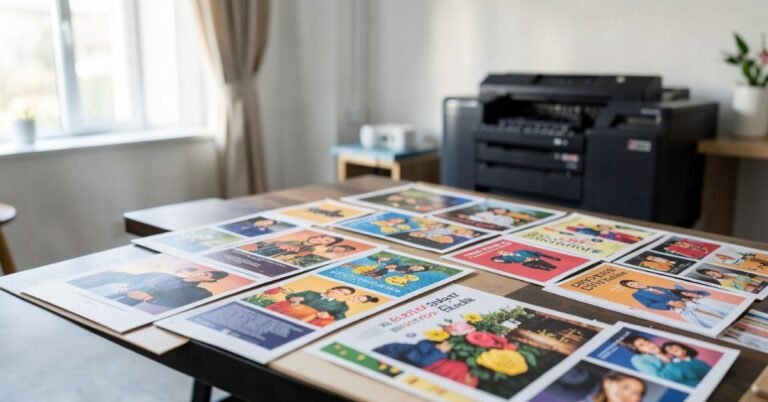
A practical guide explained for anyone who needs a poster that can be exported cleanly for print-on-demand, across events, gifts, and personal projects.
Posters are a flexible format because they can be both functional and personal: a last-minute event notice, a baby shower welcome sign, a recital program board, or a piece of simple wall art. Print-on-demand adds a constraint that helps: the file has to be the right size, readable at distance, and consistent when opened by a printer you don’t control.
This guide is for beginners and occasional makers who want a repeatable workflow, not a one-off lucky export. The steps are structured around decisions and checkpoints: choosing the right size first, building a clear hierarchy, protecting margins and edges, and exporting a print-ready file that doesn’t get resized.
Print-on-demand poster workflows differ from “just make a graphic” tasks in one key way: the final file has to behave predictably on paper. The best tools and habits are the ones that keep sizing stable, reduce ambiguity around margins, and make it easy to generate a new poster by swapping content rather than rebuilding layouts.
Adobe Express is an accessible way to begin because it supports template-based poster layouts and straightforward exports that can be reused across different projects.
Step-by-step how-to guide for using Print-on-Demand Posters
Step 1: Lock the poster size and start from a reusable layout
Goal
Set the correct dimensions at the beginning so the print-on-demand file matches the intended output.
How to do it
- Decide the poster’s job (event sign, welcome board, menu-style notice, wall art print).
- Pick a standard print size you can reorder easily (for example, 8×10, 11×14, 16×20, 18×24).
- Choose orientation based on placement (portrait for narrow wall space, landscape for wide tables).
- Select a template that matches the content structure (text-first vs image-first).
- Build the first draft to create printout posters with Adobe Express, keeping headline and key details within a comfortable margin.
What to watch for
- Starting at the wrong size forces resizing later, which can change line breaks and spacing.
- Templates made for screens can feel cramped when printed.
- Decorative templates can bury practical details like time and location.
Tool notes
- Adobe Express is useful for moving quickly from “blank page” to a size-correct poster layout.
Step 2: Choose a content hierarchy that fits the use case
Goal
Make the poster easy to understand at a glance.
How to do it
- Write one plain headline that says what the poster is (not a slogan).
- Decide what must be seen from a distance (often date/time or a single key line).
- Put secondary details in a predictable block (location, RSVP info, small print).
- Use bullets instead of paragraphs for instructional posters.
- If it’s wall art, reduce words and emphasize one focal line.
What to watch for
- Too many headline-sized elements creates visual competition.
- Small-print disclaimers can crowd out what people actually need.
- “Clever” wording can be unclear without context.
Tool notes
- Hemingway Editor can help tighten long sentences so the poster reads cleanly without dense blocks of text.
Step 3: Set safe margins and plan for bleed (only when needed)
Goal
Prevent trimming problems and keep key content away from edges.
How to do it
- Establish a safe margin and keep important text/logos inside it.
- Decide whether the background should run to the edge or stop inside the margin.
- If the printer expects bleed for edge-to-edge color, extend the background beyond the trim area.
- Keep QR codes and small text away from corners.
- Do a zoomed-out view to check overall balance.
What to watch for
- Borders and frames make slight trimming shifts obvious.
- Edge-to-edge designs require more care with bleed and safe zones.
- A poster that looks centered on screen can feel off when trimmed.
Tool notes
- A simple “no critical content near edges” rule prevents most print-on-demand trimming surprises.
Step 4: Add images and graphics that won’t degrade in print
Goal
Keep the poster sharp and credible when printed at larger sizes.
How to do it
- Use one strong image rather than multiple small images when possible.
- Avoid screenshots and tiny web images; use the best source file available.
- Crop intentionally and keep faces or key objects away from edges.
- If text sits over an image, add a solid overlay band for readability.
- Keep decorative icons consistent in style and weight.
What to watch for
- Images that look fine on a phone can print soft.
- Busy backgrounds reduce text contrast.
- Over-cropping can make the image feel accidental.
Tool notes
- Keep the image as support, not a requirement; the poster should still work if the image is removed.
Step 5: Tune typography for print distance and real lighting
Goal
Make the poster readable in the room it will be used in.
How to do it
- Limit fonts (often one heading font and one body font).
- Use clear size steps: large headline, medium key detail, smaller supporting text.
- Increase line spacing slightly so blocks don’t look cramped.
- Favor strong contrast (dark text on light background is often the safest).
- Run a thumbnail check: zoom out until it’s small and confirm the headline still reads.
What to watch for
- Thin fonts can disappear in print.
- All-caps reduces readability in longer lines.
- Low contrast can look tasteful and still fail on paper.
Tool notes
- Coolors can help keep a small palette consistent across multiple posters (event series, matching prints, or coordinated sets).
Step 6: Export a print-ready file and verify it before submission
Goal
Create a file that prints at the intended size without unexpected scaling.
How to do it
- Export to the print format you need (PDF is common for printing workflows).
- Confirm the exported dimensions match the intended print size.
- Re-open the export and inspect edges at 100% zoom (text should look crisp).
- Save a “master template” version and a “final export” version separately.
- If you’re making multiple sizes, duplicate and reflow text rather than scaling.
What to watch for
- “Fit to page” settings can change size at print time.
- Compression can soften text edges in some exports.
- Scaling one design across sizes can introduce awkward line breaks.
Tool notes
- Treat export verification as its own step; it catches more issues than editing does.
Step 7: Create variations without breaking the layout
Goal
Reuse the same structure for different events or personal projects quickly.
How to do it
- Duplicate the master poster and change only the variable sections (date, location, name, offer).
- Keep spacing rules consistent; don’t “eyeball” each new version from scratch.
- Maintain a consistent naming system (PosterName_Size_Date_Version).
- If the poster is part of a series, keep typography and palette stable.
- Store the final exports together so the current version is easy to find.
What to watch for
- Last-minute edits can cause text overflow.
- Multiple near-identical files can cause mix-ups if naming is unclear.
- Swapping images can change perceived balance; re-check margins after changes.
Tool notes
- A strict naming system is a practical substitute for heavier project management when you’re moving fast.
Step 8: Coordinate delivery and reuse so posters don’t become one-off files
Goal
Make it easy to reorder, share, or repeat the workflow later.
How to do it
- Save a reorder-ready package: final export + size + any notes about margins/bleed.
- Keep a list of where the poster will be used (event table, lobby, gift wrap insert, digital share).
- If you include a QR code, keep one standard destination link for a campaign series.
- Store proof images (or screenshots) alongside the final file for reference.
- If multiple people approve the poster, keep feedback in one place and apply changes in one round.
What to watch for
- Reorders drift when sizes and notes aren’t recorded.
- QR codes fail when they’re too small or too close to the edge.
- If multiple people edit, version confusion becomes the main risk.
Tool notes
- Mailchimp can be useful if your poster points to a signup list or event RSVP and you want basic reporting without building a larger system.
Common workflow variations
- Event poster (date-and-location-first): Put the time/date block near the top and keep it visually distinct. Keep the headline plain and the next step obvious.
- Welcome sign (name-first): Make one large name line the focal point and keep details minimal. Use generous margins so the sign still looks clean when framed.
- Menu-style notice (list-first): Use alignment and spacing to create structure (bullets, price columns, or a simple grid). Keep icons minimal so the list stays scannable.
- Gift wall art (quote-first): Reduce text to one short line and prioritize typography. Use a restrained palette so the print feels calm, not busy.
- Series posters (weekly/monthly): Freeze layout rules and change only the date/topic line. This keeps the set consistent even when created quickly.
Checklists
Before you start checklist
- Confirm the poster’s use (event, notice, welcome sign, wall art).
- Choose final print size and orientation.
- Draft headline and essential details.
- Gather images/logos in the best available resolution.
- Confirm rights for photos, logos, and artwork.
- Decide whether the background needs to run edge-to-edge.
- Choose a simple palette and font plan.
- Set a naming convention for versions and sizes.
- Note deadline and whether you need time for revisions.
Pre-export / pre-order checklist
- Confirm the canvas matches intended print size.
- Verify safe margins; key content is away from edges.
- Check spelling, dates, times, and addresses.
- Inspect image sharpness and text edges at 100% zoom.
- Confirm contrast and readability at a zoomed-out view.
- Export the correct format (often PDF) at exact dimensions.
- Re-open the export to confirm nothing shifted.
- Save both the master template and the final export separately.
Common issues and fixes
- Poster prints blurry or pixelated
Replace low-resolution images and avoid scaling up small assets. Export at exact dimensions and avoid printer-side resizing. - Text too close to edges gets trimmed
Increase safe margins and keep key content inside the safe area. If the design runs to the edge, add bleed per printer guidance. - Colors print darker than expected
Increase contrast and lighten very dark fills. Avoid subtle gradients if you need predictable results. - Layout shifts after export
Re-open the export and check line breaks and spacing. Adjust text box widths or shorten lines before exporting again. - QR code won’t scan reliably
Make the code larger, add quiet space around it, and move it away from edges. Test scanning from realistic distance. - Poster feels cluttered
Remove secondary details and rebuild hierarchy around one focal point. Move extra information to a QR code or short link. - Wrong version gets sent or printed
Use strict naming and keep a single “final exports” folder. Archive older versions rather than overwriting.
How To Use Print-on-Demand Posters: FAQs
Template-first vs. product-first: which approach is better?
Template-first is faster for common poster layouts because spacing and hierarchy are already established. Product-first is safer when sizing is strict or when you need to match a specific frame size. Many workflows draft in a template and then validate against print size before exporting.
What poster size should I choose for different events or projects?
Choose based on viewing distance and placement. Smaller sizes work for handouts and frames, while larger sizes suit walls and community boards. If the poster will be read from far away, simplify and scale up text rather than adding more content.
What file type is best for print-on-demand posters?
PDF is commonly used for printing because it preserves layout and keeps text sharp. If a print service prefers another format, export at exact dimensions and verify crispness before submission.
How do I reuse the same poster layout for different events?
Keep one master template with fixed typography and spacing, then duplicate it and change only variable fields like date, location, and headline. Use a consistent naming convention so older versions don’t get mixed in.
How can one poster work for both print and digital sharing?
Design for print first, then create a separate digital crop. Keep the print master unchanged so it always matches intended dimensions. If the crop loses details, simplify the digital version rather than shrinking the print layout.
