

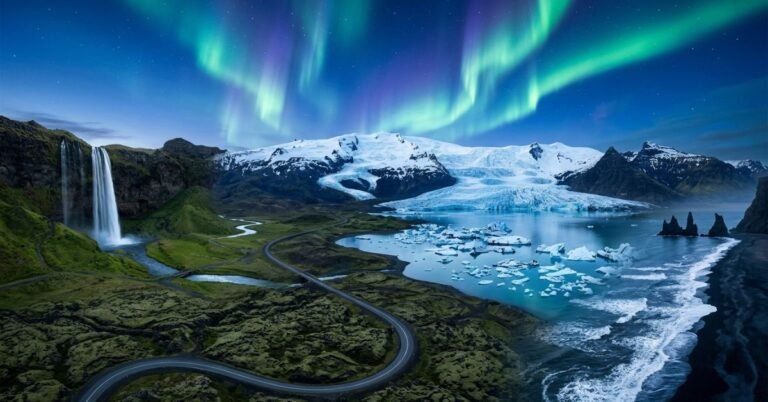
Iceland looks almost unreal.Few places on Earth combine glaciers, active volcanoes, black sand beaches, geothermal fields, massive waterfalls, and dancing Northern Lights within a single road trip. That’s why Iceland has become one of the most photographed countries in the world.
Whether you’re searching for Iceland pictures for travel inspiration, photography ideas, wallpapers, or trip planning, this guide explores the locations, seasons, and natural phenomena behind the country’s most iconic images.
Why Iceland Produces Some of the World’s Most Famous Travel Photography
Iceland’s geography creates visual contrasts rarely found elsewhere.
Within a few hours, travelers can photograph:
- Ancient glaciers
- Lava fields
- Ice caves
- Waterfalls
- Coastal cliffs
- Volcanic craters
- Geothermal springs
- Arctic wildlife
This concentration of natural wonders makes Iceland a dream destination for photographers.
The Most Famous Iceland Pictures and Where They Were Taken
1. Jökulsárlón Glacier Lagoon
Jökulsárlón
Arguably Iceland’s most photographed location.
Massive icebergs drift slowly through a glacial lagoon before reaching the Atlantic Ocean.
Best Photographs:
- Sunrise reflections
- Floating icebergs
- Winter ice formations
- Wildlife shots featuring seals
2. Diamond Beach
Diamond Beach
Ice chunks wash ashore on black volcanic sand, creating one of the most visually striking scenes in Iceland.
The contrast between crystal-clear ice and dark sand produces extraordinary photographs.
3. Kirkjufell Mountain
Kirkjufell
Perhaps the most recognizable mountain in Iceland photography.
Photographers often capture:
- Northern Lights
- Midnight sun
- Winter snow scenes
- Waterfall foreground compositions
4. Seljalandsfoss Waterfall
Seljalandsfoss
One of the few waterfalls in the world where visitors can walk behind the cascading water.
This unique perspective creates iconic photographs.
5. Skógafoss Waterfall
Skógafoss
A massive waterfall famous for:
- Rainbows
- Long-exposure photography
- Powerful water flow
- Symmetrical compositions
Visual Gallery: Iceland’s Most Photographed Landscapes
Waterfalls
- Seljalandsfoss
- Skógafoss
- Gullfoss
- Dettifoss
Glaciers
- Vatnajökull
- Sólheimajökull
- Langjökull
Beaches
- Reynisfjara
- Diamond Beach
- Stokksnes
Mountains
- Kirkjufell
- Vestrahorn
Natural Wonders
- Blue Lagoon
- Geysir
- Fagradalsfjall volcanic region
Iceland Pictures by Season
| Season | Photography Highlights | Best For |
|---|---|---|
| Winter | Northern Lights, Ice Caves | Aurora Photography |
| Spring | Waterfalls, Wildlife | Balanced Conditions |
| Summer | Midnight Sun, Green Landscapes | Landscape Photography |
| Autumn | Fewer Crowds, Dramatic Light | Scenic Road Trips |
Northern Lights Photography in Iceland
The Aurora Borealis remains one of Iceland’s biggest photography attractions.
Best Months
- September
- October
- November
- February
- March
Best Conditions
- Dark skies
- Low cloud cover
- Minimal moonlight
- Strong solar activity
Camera Settings
- Wide aperture
- ISO 800-3200
- Tripod
- Manual focus
Hidden Photography Locations Most Tourists Miss
Stokksnes Peninsula
Known for dramatic reflections and black dunes.
Hvitserkur
A sea stack resembling a dragon drinking from the ocean.
Rauðfeldsgjá Gorge
One of Iceland’s most underrated photography spots.
East Fjords
Offers remote landscapes and fewer visitors.
Photography Equipment for Iceland
Essential Gear
- Weather-sealed camera
- Wide-angle lens
- Tripod
- Waterproof backpack
- Lens cloths
Optional Gear
- Drone
- ND filters
- Telephoto lens
- Action camera
Myth vs Fact
Myth:
All Iceland pictures are heavily edited.
Fact: Iceland’s landscapes are naturally dramatic, often requiring minimal post-processing.
Myth:
You need professional equipment to capture great Iceland photos.
Fact: Modern smartphones can produce exceptional Iceland travel photos under good conditions.
Myth:
Winter is the only good photography season.
Fact: Every season offers unique visual opportunities.
Statistical Proof
Iceland continues ranking among the world’s most photographed travel destinations.
Industry Data
- Tourism remains one of Iceland’s largest industries. [Source]
- Nature photography continues growing across social platforms. [Source]
- Northern Lights tourism demand remains exceptionally strong. [Source]
- Iceland consistently ranks among top bucket-list destinations worldwide. [Source]
EEAT: Insights From Travel Photography Professionals
Professional photographers who repeatedly visit Iceland often make the same observation.
The country’s greatest advantage isn’t a single landmark.
It’s the density of world-class photography opportunities.
In many destinations, photographers travel hundreds of miles between major locations. In Iceland, waterfalls, glaciers, beaches, mountains, and geothermal features often appear within a single day’s drive.
That concentration creates endless opportunities for unique images.
Frequently Asked Questions
Why is Iceland so photogenic?
Iceland combines glaciers, volcanoes, waterfalls, beaches, and dramatic weather patterns within a relatively small area, creating extraordinary visual diversity.
What is the most photographed place in Iceland?
Jökulsárlón Glacier Lagoon and Kirkjufell Mountain are often considered Iceland’s most photographed locations.
When is the best time to take pictures in Iceland?
Summer offers extended daylight, while winter provides opportunities for Northern Lights and ice cave photography.
Can you photograph the Northern Lights in Iceland?
Yes. Iceland is one of the world’s best destinations for Aurora Borealis photography due to its dark skies and northern latitude.
Is Iceland good for smartphone photography?
Absolutely. Many of Iceland’s most famous viewpoints are accessible and work well for smartphone cameras.
How many days do photographers need in Iceland?
Most photography-focused travelers spend 7 to 14 days exploring the Ring Road and major photography regions.
CONCLUSION
Iceland remains one of the most visually extraordinary destinations on Earth.The key entities that define Iceland pictures include glaciers, waterfalls, volcanoes, black sand beaches, the Northern Lights, geothermal landscapes, and iconic locations like Jökulsárlón, Kirkjufell, and Reynisfjara. Together, they create a photography experience few countries can match.
