

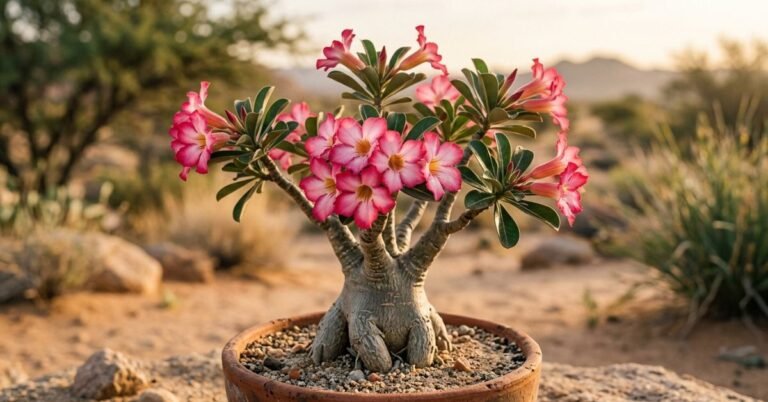
The desert rose (Adenium obesum) is a succulent flowering plant native to arid regions of Africa and the Arabian Peninsula.
Its most distinctive feature is the caudex a thickened trunk base that stores water during drought periods.
Key characteristics
| Feature | Description |
|---|---|
| Botanical Name | Adenium obesum |
| Plant Type | Flowering succulent |
| Native Regions | East Africa, Arabian Peninsula |
| Growth Form | Shrub-like succulent |
| Flower Colors | Pink, red, white, bi-color |
| Sun Requirement | Full sun |
| Water Needs | Low (drought adapted) |
| Toxicity | Sap is toxic |
Why Desert Rose Looks “Different” From Other Plants
Most plants rely on steady watering cycles.
Desert rose doesn’t.
Instead, it uses its caudex like a built-in reservoir. During dry periods, it survives by slowly consuming stored water. When conditions improve, it produces rapid growth and flowering.
This is why:
- It drops leaves suddenly (normal survival response)
- It thrives in heat and sunlight
- It struggles in constantly moist soil
Ideal Growing Conditions
Sunlight
Desert rose needs intense light.
- 6–8 hours direct sunlight
- South-facing window indoors
- Outdoor full sun in warm climates
Without enough light, it becomes leggy and refuses to flower.
Soil (Most Important Factor)
This is where most growers fail.
Desert rose needs extremely fast drainage.
Recommended soil mix:
- 50% cactus soil
- 30% coarse sand or perlite
- 20% pumice or gravel
The goal is simple: water should pass through quickly, never sit.
Watering Schedule
Watering is less about timing and more about dryness.
Rule of thumb:
- Water only when soil is completely dry
- In hot season: every 7–10 days
- In cool season: every 2–4 weeks
Overwatering is the #1 cause of death.
Why Desert Rose Stops Flowering
This is one of the most common user frustrations.
Main causes:
- Not enough sunlight
- Too much nitrogen fertilizer
- Overwatering
- No seasonal stress cycle
- Poor pruning habits
Flowering is triggered by controlled stress + strong light exposure.
How to Prune for Shape (Bonsai Style Growth)
Desert rose responds extremely well to pruning.
Goals of pruning:
- Encourage branching
- Create thicker caudex
- Control height
- Improve flower density
Technique:
- Prune during active growth season
- Cut above leaf nodes
- Allow multiple new branches to form
Over time, this creates a natural bonsai-like structure.
Propagation Methods
From Cuttings
- Fast but less stable caudex formation
From Seeds
- Slower
- Produces thicker, more natural trunk
- Preferred for bonsai shaping
Common Problems and Fixes
Root Rot
Cause: Constant moisture
Fix: Improve drainage, reduce watering immediately
Yellow Leaves
Cause: Overwatering or seasonal dormancy
Fix: Check soil dryness before reacting
No Flowers
Cause: Low light or excess nitrogen
Fix: Increase sun exposure and switch fertilizer
Desert Rose vs Other Succulents
| Plant | Water Tolerance | Flowering | Maintenance |
| Desert Rose | Moderate | High | Medium |
| Cactus | Very High | Low–Moderate | Low |
| Plumeria | Moderate | High | Medium |
| Euphorbia | High | Variable | Low |
Desert rose stands out because it combines sculptural form + vibrant flowers.
Toxicity Warning
Desert rose produces a milky sap that is toxic if ingested.
- Keep away from pets
- Avoid contact with eyes or mouth
- Wash hands after pruning
Myth vs Fact
Myth:
Desert rose needs frequent watering.
Fact:
It is drought-adapted and prefers dry soil cycles.
Myth:
Leaf drop means the plant is dying.
Fact:
Leaf drop is often a normal response to environmental change.
Myth:
It grows like a typical houseplant.
Fact:
It behaves more like a succulent shrub with seasonal cycles.
Statistical & Environmental Context
Succulent plants like Adenium obesum are increasingly popular in arid-climate landscaping because they reduce water usage significantly compared to traditional ornamental plants. [Source: FAO Water Use in Horticulture Reports]
Indoor plant ownership has also risen globally, with flowering succulents gaining popularity due to their low maintenance requirements and high visual impact. [Source: Royal Horticultural Society Trends Report]
EEAT Insight: What Experienced Growers Notice
From years of working with desert rose specimens in both greenhouse and outdoor environments, the biggest misconception is that the plant is fragile.
In reality, it is highly resilient but extremely sensitive to overcare.
The healthiest plants are not the most watered or fertilized. They are the ones placed in full sun, grown in gritty soil, and allowed to follow natural wet-dry cycles without interference.
That “hands-off” approach is what produces thick caudex development and reliable flowering.
Seasonal Care Guide
Spring
- Resume watering gradually
- Begin fertilization (low nitrogen)
- Repot if necessary
Summer
- Peak growth period
- Full sun exposure
- Regular but controlled watering
Autumn
- Reduce watering frequency
- Stop fertilization
Winter
- Dormant period
- Minimal watering
- Protect from cold
FAQ
Why is my desert rose dropping leaves?
This is usually a response to stress such as temperature change, reduced light, or seasonal dormancy. In most cases, it is normal and temporary.
How often should I water desert rose?
Only water when the soil is completely dry. Frequency depends on climate, but typically every 7–14 days during warm months and less in winter.
Can desert rose grow indoors?
Yes, but only if it receives strong direct sunlight or grow lights. Without adequate light, flowering will be minimal.
Why is my desert rose not blooming?
Lack of sunlight, overwatering, or excess nitrogen fertilizer are the most common causes. Adjusting these usually restores flowering.
Is desert rose toxic?
Yes. The sap is toxic and should not be ingested. Keep away from pets and children.
Can desert rose be shaped like bonsai?
Yes. With regular pruning and controlled growth conditions, it can be trained into sculptural bonsai-style forms.
Conclusion
Desert rose (Adenium obesum) is not a typical houseplant it’s a living sculpture shaped by sunlight, drought cycles, and careful restraint.
Once you understand its biology especially the caudex system, water storage behavior, and flowering triggers it becomes far easier to grow and far more rewarding to shape.
