

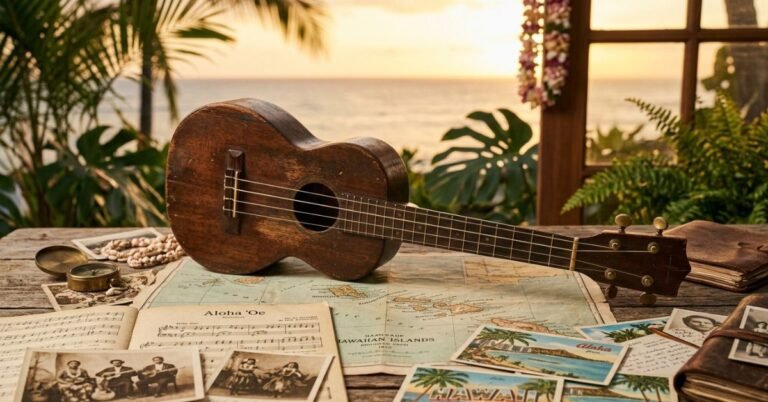
Ukulele’s direct ancestor is the machete (or machete de braga, also called braguinha), a small four-stringed instrument from the island of Madeira, Portugal. Portuguese cabinetmakers and immigrants brought versions of this and related instruments (like the rajão and cavaquinho) to Hawaii in the late 1870s.
In August 1879, the ship SS Ravenscrag arrived in Honolulu carrying Portuguese sugar plantation workers. Among them were skilled woodworkers Manuel Nunes, Augusto Dias, and José do Espírito Santo often credited as the first ukulele makers in Hawaii. They adapted the machete using local woods (like koa), refining the design into what we recognize today.
The name “ukulele” is pure Hawaiian. It translates to “jumping flea,” referring to the lively, flea-like movement of the player’s fingers across the fretboard.
Royal Adoption and Hawaiian Identity
Hawaiian royalty played a pivotal role in popularizing the instrument. King David Kalākaua, known for reviving Hawaiian culture, embraced it enthusiastically and incorporated it into court music and celebrations. Queen Liliʻuokalani, a talented musician and composer of “Aloha ʻOe,” also supported it and reportedly called it the national instrument.
By the 1880s–1890s, the ukulele had become deeply woven into Hawaiian music, accompanying hula and folk songs. Local makers like the Kamaka family (founded in 1916) elevated craftsmanship, using premium Hawaiian woods and innovations that set standards still followed today.
Ukulele History Timeline
- 1879: Portuguese immigrants arrive on SS Ravenscrag; machete introduced.
- 1880s: First Hawaiian workshops open; instrument named “ukulele.”
- 1890s–1900s: Gains traction across the islands with royal endorsement.
- 1915: Panama-Pacific International Exposition in San Francisco introduces Hawaiian music and the ukulele to mainland America.
- 1920s: Jazz Age boom; millions sold in the U.S.; Tin Pan Alley publishes ukulele chord sheets.
- 1930s–1950s: Stars like Cliff “Ukulele Ike” Edwards, George Formby (UK), and Arthur Godfrey keep it popular.
- 1960s–1970s: Tiny Tim’s viral hit and the Hawaiian Cultural Renaissance (Eddie Kamae and others) revive interest.
- 1990s–2000s: Israel Kamakawiwoʻole’s “Somewhere Over the Rainbow” becomes a global phenomenon.
- 2010s–2026: Jake Shimabukuro, viral YouTube/TikTok players, and school programs fuel ongoing growth.
Global Spread and Cultural Impact
The 1915 San Francisco exposition was the big breakout moment. Hawaiian performers wowed crowds, sparking a “Hawaiian craze.” The ukulele became a fad instrument affordable, portable, and fun for beginners. It crossed the Atlantic too, with British star George Formby popularizing the banjo-ukulele.
In the U.S., it featured in vaudeville, movies, and radio. Later revivals tied it to folk, indie, and even rock (think George Harrison). Today, it’s a staple in music education worldwide.
Comparison: Ukulele Sizes and Their Roles
| Size | Scale Length | Typical Use | Tone Characteristics |
|---|---|---|---|
| Soprano | 13″ | Traditional, bright & classic | Crisp, classic “uke” sound |
| Concert | 15″ | Balanced volume & playability | Fuller than soprano |
| Tenor | 17″ | Soloing, louder projection | Warmer, versatile |
| Baritone | 19″ | Guitar-like, lower range | Deep, mellow |
Myth vs. Fact
Myth: The ukulele was invented in Hawaii from scratch. Fact: It evolved from Portuguese instruments brought by immigrants in 1879.
Myth: It’s only for beginners or novelty songs. Fact: Virtuosos like Jake Shimabukuro and Taimane Gardner prove it’s a serious instrument capable of complex music.
Myth: All early ukuleles were made of koa. Fact: Early makers used various woods; koa became iconic later.
Statistical Snapshot (2025–2026)
The global ukulele market continues expanding, with estimates placing it around $350–500+ million in recent years and projected strong growth through the 2030s, driven by education, social media, and accessibility. School programs and online learning have broadened its appeal across generations.
EEAT Insight: Observations from Years in the Ukulele Community
After following the scene closely talking with makers, players, and historians one truth stands out: the ukulele’s endurance comes from its accessibility without sacrificing soul. The common mistake newcomers make is dismissing it as a toy. Treat it with good technique and decent setup, and it rewards you with years of musical joy. Modern builders honor the Portuguese-Hawaiian roots while innovating sustainably.
FAQs
Where did the ukulele originally come from? It evolved in Hawaii from the Portuguese machete (braguinha), brought by immigrants from Madeira in 1879. Hawaiians adapted and renamed it.
What does “ukulele” mean? “Jumping flea” in Hawaiian, describing the fast finger movements when playing.
Who invented the ukulele? No single inventor. Key figures include Portuguese craftsmen Manuel Nunes, Augusto Dias, and José do Espírito Santo, who built early versions in Hawaii.
When did the ukulele become popular in America? It exploded after the 1915 Panama-Pacific Exposition in San Francisco, with a major boom in the 1920s.
Is the ukulele still popular in 2026? Yes. Educational programs, social media, and its portable nature keep driving steady growth worldwide.
What is the most famous ukulele song? Israel Kamakawiwoʻole’s medley of “Somewhere Over the Rainbow / What a Wonderful World” remains iconic, alongside classics like “Aloha ʻOe.”
Conclusion
From a humble Portuguese machete on a sugar plantation ship to a global symbol of joy and creativity, the ukulele’s history is one of cultural fusion and resilience. It carries Hawaiian spirit, immigrant ingenuity, and the simple pleasure of making music anywhere.
