

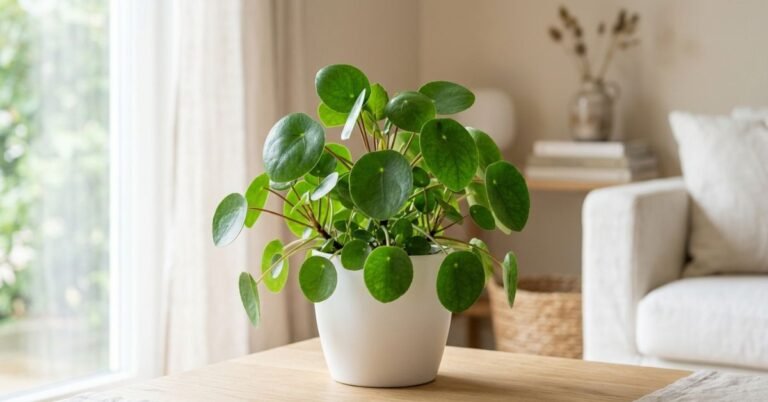
The Chinese money plant (Pilea peperomioides) is a small perennial houseplant native to the Yunnan region of Southwest China.
It became globally popular through Scandinavian plant collectors, earning it the nickname “UFO plant” due to its perfectly round leaves.
Key Characteristics
| Feature | Description |
|---|---|
| Botanical Name | Pilea peperomioides |
| Plant Type | Herbaceous perennial |
| Native Region | Southwest China |
| Growth Style | Upright with offsets |
| Leaf Shape | Round, coin-like |
| Light Preference | Bright indirect light |
| Propagation | Offsets (pups) |
Why the Chinese Money Plant Became So Popular
It’s not just aesthetic.
It fits modern indoor life perfectly:
- Compact size
- Minimal maintenance
- Fast propagation
- Clean, architectural shape
- High visual symmetry
It also aligns with Feng Shui symbolism, where round leaves represent prosperity and positive energy flow.
Ideal Growing Conditions
Light Requirements (Most Important Factor)
This plant is extremely light-sensitive.
Best lighting:
- Bright indirect sunlight
- Near east or north-facing windows
- Filtered light through curtains
What to avoid:
- Harsh direct sun (leaf burn)
- Deep shade (leggy growth)
Light directly controls leaf size and spacing.
Watering Schedule
The Chinese money plant prefers balance not dryness, not soggy soil.
Rule of thumb:
- Water when top 2–3 cm of soil is dry
- Usually once every 7–10 days indoors
Signs of watering issues:
- Drooping leaves → underwatering or shock
- Yellow leaves → overwatering
- Mushy stems → root rot risk
Soil Requirements
Drainage matters more than fertilizer.
Ideal soil mix:
- 60% potting soil
- 20% perlite
- 20% coco coir or bark
This ensures:
- Airflow around roots
- Controlled moisture retention
- Reduced risk of rot
Why Leaves Curl or Droop
This is one of the most searched problems.
Causes:
- Sudden light change
- Overwatering
- Underwatering
- Temperature stress
- Root congestion
Key insight:
This plant responds quickly to environmental changes. Leaf behavior is its communication system.
Propagation (The “Pup” System Explained)
The Chinese money plant reproduces through offsets called “pups.”
Why it produces pups:
It’s a survival strategy. Instead of relying on seeds, it clones itself near the parent plant.
How to propagate:
- Locate healthy pup at soil line
- Wait until it has small roots
- Gently remove with clean knife
- Place in water or soil
- Maintain humidity for first 2 weeks
Growth Stages Explained
Stage 1: Establishment
Slow root development
Stage 2: Vertical growth
Main stem elongation begins
Stage 3: Offset production
Pups appear at base
Stage 4: Mature symmetry
Balanced leaf spacing and strong structure
Chinese Money Plant vs Similar Houseplants
| Plant | Growth Style | Maintenance | Propagation |
| Pilea peperomioides | Upright + pups | Easy | Very easy |
| Spider Plant | Arching | Easy | Very easy |
| Monstera | Vining | Medium | Medium |
| Peperomia | Compact | Easy | Moderate |
Common Problems and Fixes
Yellow Leaves
Cause: Overwatering
Fix: Improve drainage, reduce watering frequency
Leaning or Stretching
Cause: Uneven light
Fix: Rotate plant weekly
No New Growth
Cause: Low light or root crowding
Fix: Repot and increase light exposure
Myth vs Fact
Myth:
Chinese money plant is a true “lucky plant.”
Fact:
It is symbolic in Feng Shui, but scientifically it’s a standard tropical houseplant.
Myth:
It grows well in low light.
Fact:
It survives low light but thrives in bright indirect light.
Myth:
More water makes it grow faster.
Fact:
Overwatering slows growth and damages roots.
Statistical & Indoor Plant Trend Insights
Indoor plant ownership has increased significantly in urban households, driven by wellness, aesthetics, and air-quality awareness. Studies show houseplants improve perceived indoor comfort and visual relaxation. [Source: Royal Horticultural Society]
Propagation-based houseplants like Pilea peperomioides are especially popular due to their ability to multiply quickly without additional purchases. [Source: Indoor Horticulture Market Reports]
EEAT Insight: Real-World Grower Perspective
From working with indoor foliage plants in controlled environments, the most consistent mistake is treating Pilea like a “set and forget” plant.
It’s not high maintenance, but it is highly responsive. Even small shifts in light or watering routine reflect quickly in leaf posture and color.
The healthiest plants are not over-managed. They are placed in stable light conditions and allowed to grow without frequent environmental changes.
Seasonal Behavior Indoors
Spring
Fastest growth period, active pup production
Summer
Stable growth, requires consistent watering
Autumn
Slower growth, adjust watering
Winter
Dormant phase, minimal water needed
FAQ
Why is my Chinese money plant drooping?
Drooping is usually caused by watering imbalance, sudden light change, or root stress. Check soil moisture first before making adjustments.
How often should I water a Chinese money plant?
Typically every 7–10 days indoors, but always check soil dryness first. It prefers slight drying between watering cycles.
Why is my Pilea not producing pups?
Low light, immature plant age, or nutrient imbalance can delay pup formation. Bright indirect light encourages reproduction.
Can Chinese money plant grow in low light?
It can survive, but growth will slow significantly and leaves may lose their compact round shape.
Is Chinese money plant toxic to pets?
It is considered non-toxic to cats and dogs, making it a safe indoor plant choice.
How do I make my plant more bushy?
Rotate it regularly, ensure bright indirect light, and propagate pups back into the same pot for a fuller appearance.
Conclusion
The Chinese money plant (Pilea peperomioides) is more than a decorative houseplant. It’s a responsive biological system shaped by light, water balance, and propagation cycles.
Once you understand how it communicates through leaf posture, pup production, and growth direction, it becomes one of the most rewarding indoor plants to maintain.
As indoor gardening continues to grow globally, plants like Pilea are becoming central to modern home design simple, expressive, and endlessly shareable.
