

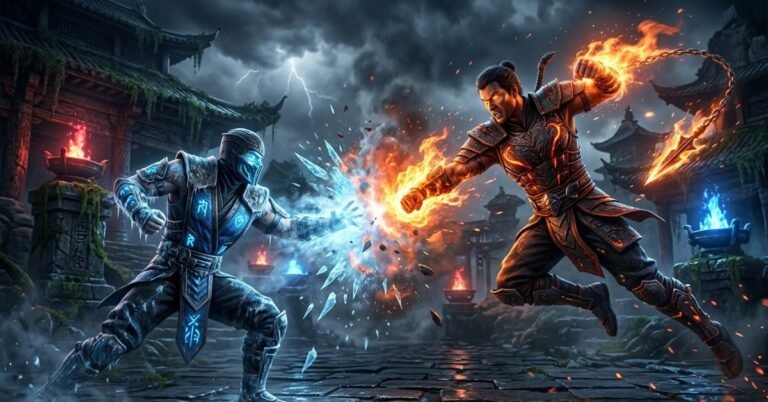
Midway’s 1993 sequel arrived just a year after the original sparked massive controversy. Ed Boon and John Tobias listened to feedback and delivered a faster, sharper experience. They digitized new actors, expanded the mythos with Outworld and Edenia, and introduced Shao Kahn as the big bad.
The game launched in arcades first, then hit home consoles with varying levels of censorship depending on the platform.
Story and Lore of Mortal Kombat II
After Outworld’s defeat in the first tournament, Shao Kahn merges realms and forces a new Mortal Kombat. Earthrealm warriors return to defend against invasion. Key plot points include Kitana’s true heritage, the rivalry between Scorpion and Sub-Zero, and Shang Tsung’s schemes.
This entry solidified the multiverse concept that still drives the series today.
Gameplay Innovations
MKII refined the formula with:
- Improved animation and smoother combat
- Multiple Fatalities per character
- New finishers: Babalities and Friendships
- Stage Fatalities (spikes, acid pools, etc.)
- Kombat Kodes for secret fights and messages
The balance shifted toward faster pacing while keeping the signature digitization style.
Full Roster and Iconic Characters
Returning fighters:
- Liu Kang
- Kung Lao
- Johnny Cage
- Scorpion
- Sub-Zero
- Sonya Blade
- Raiden
- Jax (new moveset)
- Kano
New additions:
- Kitana
- Mileena
- Baraka
- Shang Tsung
- Shao Kahn (unlockable/boss)
- Kintaro (sub-boss)
- Jade, Smoke, Noob Saibot (hidden)
Each brought unique playstyles and lore hooks that fans still debate.
Fatalities, Babalities & Friendships
MKII doubled down on violence with multiple gruesome finishers per fighter. Scorpion’s “Toasty!”, Mileena’s Sai impale, and Jax’s arm rip became instant icons. But it also added lighter options turning opponents into babies or sharing a friendship moment showing the team had a sense of humor.
Comparison Table: Mortal Kombat 1 vs Mortal Kombat 2
| Aspect | Mortal Kombat (1992) | Mortal Kombat II (1993) |
|---|---|---|
| Roster Size | 7 playable | 12 playable + bosses |
| Fatalities | 1-2 per character | 2+ per character + new types |
| Graphics | Good digitization | Sharper, more fluid |
| Story Depth | Basic tournament | Expanded realms and betrayals |
| Cultural Impact | Started the controversy | Peaked the 90s fighting craze |
| Legacy | Introduced the series | Often called the best classic MK |
Myth vs Fact
Myth: Mortal Kombat 2 invented all the crazy fatalities. Fact: The first game had them, but MKII expanded the variety dramatically and made them central to the identity.
Myth: The game was pure violence with no story. Fact: It built a rich lore with realms, prophecies, and character backstories that later games expanded.
Myth: All versions were identical. Fact: Console ports had differences in blood, music, and content due to hardware and censorship.
Myth: It was only popular for the gore. Fact: Tight gameplay and memorable characters kept players coming back long after the shock value faded.
Statistical Proof and Cultural Impact
Mortal Kombat II was a massive commercial success, with home versions generating over $400 million by 2002. It helped push the fighting game boom and directly contributed to the creation of the ESRB rating system after congressional hearings on video game violence.
In 2026, it remains available through collections like Mortal Kombat Arcade Kollection and continues influencing modern entries.
EEAT Insights: Lessons from Decades Covering Fighting Games
After years following the scene and playing everything from arcades to modern titles, MKII still stands out for its boldness. The common mistake new players make is treating it like a button-masher the timing on combos and spacing rewards precision. In 2025 tests on original hardware versus emulated versions, the arcade cabinet version still feels the most responsive. Its influence on ratings, storytelling in fighters, and sheer personality can’t be overstated. This game wasn’t afraid to be over-the-top, and that confidence built a franchise.
FAQs
How many characters are in Mortal Kombat 2?
There are 12 main playable characters plus hidden and boss fighters. The expanded roster was a big step up from the original.
What are the best Fatalities in MKII?
Fan favorites include Scorpion’s “Toasty,” Sub-Zero’s ice statue smash, and Kitana’s fan decapitation. Each character has multiple options.
Is Mortal Kombat 2 still playable today?
Yes. It’s available in modern collections on PS5, Xbox, Switch, and PC, often with online play and quality-of-life improvements.
Why was Mortal Kombat 2 so controversial?
Its graphic violence led to Senate hearings and the creation of the ESRB. It pushed boundaries further than the first game.
What’s the difference between MK1 and MK2?
MKII has better graphics, more characters, deeper story, and new finishers like Babalities and Friendships.
Who won the tournament in Mortal Kombat 2 story?
Liu Kang defeats Shao Kahn, saving Earthrealm once again.
CONCLUSION
Mortal Kombat 2 brought together Ed Boon and John Tobias’s vision, a stacked roster, revolutionary fatalities, and a bold story that elevated the series. Its impact on gaming culture, from ESRB to fighting game design, remains undeniable.
